
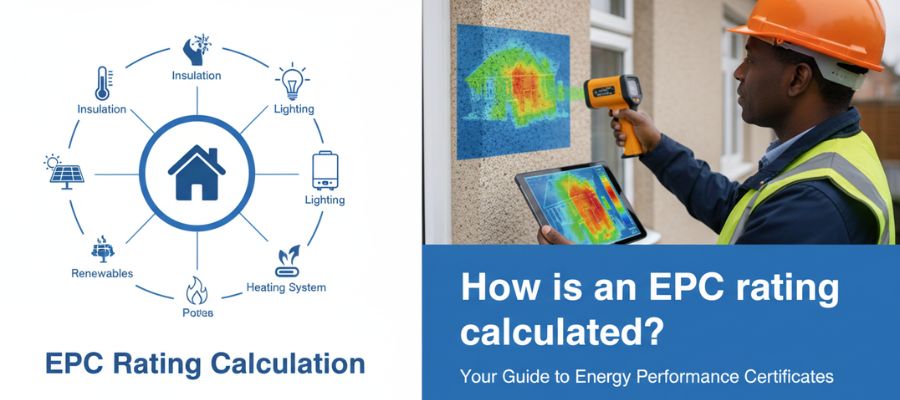
How is an EPC rating calculated?
If you’re booking an EPC in Bedfordshire, Hertfordshire, Buckinghamshire or North London, it’s natural to ask: how is an EPC rating calculated? Is it just your boiler, or do things like windows, insulation and lights matter too?
This guide walks you through exactly how EPC is calculated, step by step, in simple language. By the end, you’ll know what affects your score – and what to improve before the assessor arrives.
Quick answer: how are EPC ratings calculated?
In the UK, EPC ratings are calculated using a government-approved method called SAP (Standard Assessment Procedure) or RdSAP (Reduced Data SAP for existing homes).
Here’s the simple flow:
-
An accredited domestic energy assessor visits your property.
-
They collect data on:
-
walls, roof, floors and insulation
-
windows and doors
-
heating and hot water systems
-
heating controls
-
lighting and any renewables (solar, heat pumps, etc.).
-
-
All this is entered into SAP/RdSAP software, which:
-
estimates the energy needed to heat and light your home
-
factors in fuel costs and carbon emissions.
-
-
The software produces a score from 1–100+, which is then converted into a band:
-
A = 92–100
-
B = 81–91
-
C = 69–80
-
D = 55–68
-
E = 39–54
-
F = 21–38
-
G = 1–20
-
That’s the core of “EPC rating – how is it calculated?”
Now let’s go deeper.
What an EPC rating actually measures
Before talking numbers, it helps to know what is being measured.
An EPC gives your home an “asset rating” – an energy score based on:
-
the fabric of the building (walls, roof, floors, windows)
-
the fixed services (heating, hot water, lighting, renewables).
It does not look at:
-
your personal habits
-
how long you shower
-
how many TVs you have plugged in.
So when you ask:
-
how are EPC ratings calculated?
-
EPC – how is it calculated?
-
how an EPC is calculated for my house?
…the answer is:
By modelling how your building would perform under standard, assumed usage, not your real-life bills.
SAP vs RdSAP: the engine behind how EPC is calculated
You’ll often see two acronyms:
-
SAP – Standard Assessment Procedure
-
RdSAP – Reduced Data SAP
They are both official UK methods used to calculate EPCs.
SAP – for new builds
SAP is usually used for:
-
new-build houses and flats
-
some conversions and major renovations.
It’s very detailed and uses:
-
full construction specifications
-
exact U-values for walls, roofs and floors
-
airtightness test results (where available).
RdSAP – for existing homes
RdSAP is used for most existing homes in:
-
Bedford, Luton, Dunstable, Leighton Buzzard, Ampthill, Flitwick
-
St Albans, Watford, Hemel Hempstead, Stevenage, Hitchin, Harpenden
-
Milton Keynes, Aylesbury, High Wycombe, Buckingham, Amersham, Chesham
-
Barnet, Enfield, Haringey, Camden, Islington, Hackney.
Because you don’t usually have full drawings, RdSAP:
-
uses key data from the assessor’s visit
-
fills gaps with standard assumptions based on the age and type of the property.
So, if you’re asking “how is EPC calculated for my 1930s semi in Watford or my flat in Hackney?”, the real answer is:
It’s calculated using RdSAP software, fed with data your assessor collects on site.
Step-by-step: how are energy performance certificates calculated during the visit?
Here’s what actually happens when the assessor is in your home.
1. Property type and size
They start by identifying:
-
house, bungalow or flat
-
detached, semi, mid-terrace, end-terrace
-
how many floors
-
the dimensions of each floor.
This tells the software:
-
the total floor area
-
how much external surface (walls, roof, floor) is exposed to the outside.
A mid-terrace in Luton or Camden usually loses less heat than a detached house in Leighton Buzzard or Aylesbury, so that alone can influence the rating.
2. Walls, roof and floor – insulation and construction
Next, they look at how your home is put together:
-
wall type:
-
solid brick
-
cavity wall
-
timber frame
-
-
wall insulation:
-
cavity filled
-
internal insulation
-
external insulation
-
-
roof type and loft insulation:
-
pitched or flat roof
-
depth of loft insulation in mm
-
-
floor type:
-
solid concrete
-
suspended timber.
-
Better insulation = less heat loss = a better SAP / RdSAP score, which improves your band.
So if two similar homes exist in Milton Keynes, one with 270mm loft insulation and filled cavity walls will usually beat one with minimal insulation.
3. Windows and external doors
The assessor then checks:
-
single, double or triple glazing
-
age and type of frames (old aluminium, uPVC, modern timber)
-
visible signs of low-E coatings or energy-efficient glass
-
draughty or modern external doors.
If exact details aren’t available, the software uses typical performance values for the age and style of the property.
Upgrading from old single glazing to modern double or triple glazing can improve how your EPC rating is calculated, because the assumed heat loss through windows is lower.
4. Main heating system – a big part of how EPC is calculated
For many homes in Bedfordshire, Hertfordshire, Buckinghamshire and North London, the main heating system is one of the biggest influences on the EPC.
The assessor records:
-
system type:
-
gas boiler
-
oil boiler
-
LPG
-
electric storage heaters
-
direct-acting electric panels
-
heat pumps (air source or ground source)
-
-
boiler details:
-
make and model (if visible)
-
efficiency taken from a product database
-
-
heat distribution:
-
radiators
-
underfloor heating
-
-
heating controls:
-
programmer / timer
-
room thermostat
-
thermostatic radiator valves (TRVs)
-
smart controls.
-
Because gas is cheaper per kWh than electricity and modern condensing boilers are more efficient, a newer gas boiler with good controls often scores better than old electric panel heaters.
That’s why, if you ask “EPC rating – how is it calculated in my Barnet or St Albans rental?”, the heating system is usually near the top of the list.
5. Secondary heating
If you have extra heaters, they are recorded as secondary heating, such as:
-
a wood-burning stove
-
an open fire
-
individual electric panel heaters.
The software assumes a certain percentage of heat demand met by these and factors in their:
-
fuel type
-
efficiency.
Some secondary systems (like efficient stoves) are relatively neutral or slightly positive; very inefficient ones can pull the rating down.
6. Hot water system
The assessor also logs how you get your hot water:
-
combi boiler
-
boiler + hot water cylinder
-
electric immersion heater
-
hot water from heat pump
-
solar hot water panels.
Details that matter:
-
whether the hot water cylinder is factory-insulated
-
thickness of any extra cylinder jacket
-
cylinder size and location (inside or outside the heated space).
Poorly insulated cylinders and old immersion-only systems generally make the calculation less favourable.
7. Fixed lighting
EPC methodology only looks at fixed lighting, not plug-in lamps.
The assessor will check a sample of rooms and record:
-
how many fixed fittings exist
-
how many use:
-
LED or low-energy lamps
-
old halogen / incandescent bulbs.
-
The more efficient the lighting, the lower the assumed electricity use, giving a modest improvement to your EPC score.
8. Renewable technologies
Any renewables are carefully recorded, for example:
-
solar PV (roof panels generating electricity)
-
solar thermal (hot water panels)
-
heat pumps
-
biomass boilers.
For solar PV, the assessor considers:
-
total kWp
-
orientation (south, east, west)
-
roof pitch.
The SAP / RdSAP model then reduces the net electricity you’re assumed to buy from the grid. This all feeds back into how your EPC is calculated, often nudging you up a band.
If you’ve fitted solar in Hitchin, Harpenden, High Wycombe or Islington and your old EPC was done before installation, a new EPC can dramatically improve the calculated rating.
Inside the software: EPC rating – how is it calculated in numbers?
Once the data is in the software, the real calculation begins. Here’s the technical backbone of how EPC ratings are calculated.
1. Standard assumptions
The software doesn’t know how you live, so it uses standard assumptions about:
-
occupancy (how many people, based on floor area)
-
heating patterns (hours per day, temperature set-points)
-
hot water usage.
This keeps things consistent between a flat in Camden and a detached house in Buckingham, so EPCs are comparable.
2. Annual energy demand
Using all the inputs, the model estimates annual energy demand for:
-
space heating
-
hot water
-
fixed lighting.
It also considers:
-
heat losses through fabric and ventilation
-
solar gains
-
internal gains (from people and appliances, using standard assumptions).
3. Fuel prices and carbon factors
Each fuel has:
-
a price per kWh (for running-cost-based ratings)
-
a carbon emission factor per kWh (for environmental rating).
Gas is typically cheaper and lower-carbon than traditional electric resistance heating, so, all else equal, a gas system usually scores better.
4. SAP / RdSAP score
From these calculations, the software produces a numerical SAP / RdSAP score, roughly:
-
1 = extremely poor
-
100+ = exceptional (sometimes with on-site generation exporting energy).
5. Score → EPC band
Finally, that score is converted into the EPC band you see on your certificate:
-
A: 92–100
-
B: 81–91
-
C: 69–80
-
D: 55–68
-
E: 39–54
-
F: 21–38
-
G: 1–20
So when you ask, “EPC rating – how is it calculated in the UK?”, the short version is:
building data → SAP/RdSAP model → score → band (A–G).
Does location change how EPC is calculated?
The good news: no.
The way EPC is calculated is set by UK regulations and the SAP / RdSAP methodology. It’s the same in:
-
Bedford, Luton, Dunstable, Leighton Buzzard, Ampthill, Flitwick
-
St Albans, Watford, Hemel Hempstead, Stevenage, Hitchin, Harpenden
-
Milton Keynes, Aylesbury, High Wycombe, Buckingham, Amersham, Chesham
-
Barnet, Enfield, Haringey, Camden, Islington, Hackney.
What changes with location is:
-
the typical housing stock (Victorian terraces vs. newer estates)
-
how many homes already have:
-
good insulation
-
condensing boilers
-
heat pumps or solar.
-
But how EPC is calculated remains the same across those areas.
Why two similar houses can have different EPC ratings
You might see two near-identical 3-bed semis in St Albans or Barnet with different ratings – one C, one D. How can that be, if EPC is calculated with the same method?
Common reasons:
-
Different upgrades
-
one has a modern condensing boiler, the other an old non-condensing model
-
one has 270mm loft insulation, the other 100mm.
-
-
Cavity wall insulation
-
one has had cavities filled
-
the other hasn’t, so the software assumes higher heat loss.
-
-
Glazing
-
one has recent A-rated double glazing
-
the other still has older units or some single glazing.
-
-
Evidence provided
-
if the homeowner shows certificates or paperwork for insulation or boiler efficiency, the assessor can enter more favourable values instead of defaults.
-
Because how EPC is calculated relies partly on assumptions where exact data is missing, having documentation ready can directly improve the calculated rating.
How an EPC is calculated for different property types
Houses vs flats
The same SAP/RdSAP methodology is used for both, but:
-
flats often share walls and floors with heated spaces above/below
-
this reduces heat loss in the model.
So, a flat in Islington or Watford might get a better EPC rating than an older, exposed detached house in Bedford or Buckingham, even with similar heating systems.
Old vs new
-
New-build homes are usually assessed with full SAP
-
Older homes use RdSAP with more assumptions.
New builds often score better because:
-
they must meet stricter building regulations
-
they’re designed with insulation and airtightness in mind.
But older homes can still move up the scale with the right improvements.
How to improve your EPC once you know how it’s calculated
Because you now understand how EPC is calculated, you can focus on the parts that move the needle most:
-
Insulation
-
top up loft insulation to at least recommended levels
-
consider cavity wall insulation where suitable.
-
-
Heating system
-
upgrade an old boiler to a modern condensing model
-
consider a heat pump if appropriate for the property.
-
-
Heating controls
-
add room thermostats, TRVs and good programmers
-
smart heating controls can also help.
-
-
Windows and doors
-
upgrade to energy-efficient double or triple glazing where cost-effective.
-
-
Lighting
-
switch all fixed fittings to LED.
-
-
Renewables
-
add solar PV or solar hot water if the property and budget allow.
-
Targeted improvements in these areas are exactly what the software rewards when working out how your EPC rating is calculated.
FAQs – EPC rating: how is it calculated?
How are EPC ratings calculated?
EPC ratings are calculated by an accredited assessor using government-approved SAP or RdSAP software. The assessor collects data on your home’s construction, insulation, heating, hot water, lighting and any renewables, then the software estimates annual energy use and running costs. That produces a score from 1–100+, which is then converted into an EPC band from A to G.
How is EPC calculated for an existing home?
For existing homes, EPC is usually calculated using RdSAP (Reduced Data SAP). The assessor records visible details and uses official assumptions for anything that can’t be measured directly, like some construction elements based on property age. The software then calculates a score and assigns the EPC rating.
How are energy performance certificates calculated if I live in a flat?
For flats, the assessor looks at the same things – walls, windows, heating, hot water, lighting and renewables – but the software also takes into account that some walls, floors and ceilings are shared with other heated spaces. This often reduces heat loss in the model, which can help the EPC rating for flats in blocks in places like Milton Keynes, Watford or Camden.
EPC – how is it calculated if I have solar panels?
If you have solar PV or solar hot water, the assessor records the system size and orientation. The software then reduces the amount of energy your home is assumed to import from the grid or generate from other fuels. That lower net energy demand feeds into the SAP/RdSAP score and can improve your EPC band.
EPC rating – how is it calculated for rentals?
For rental properties, EPC ratings are calculated exactly the same way as for owner-occupied homes. The key difference is legal: as a landlord you must meet minimum EPC standards when letting in England. But the actual method – assessor visit, SAP/RdSAP software, score and band – is identical.
How an EPC is calculated – does my actual energy bill matter?
No. Your real energy bills and personal usage patterns do not go into the calculation. The EPC uses standard assumptions about occupancy and heating patterns so that two homes can be fairly compared. What matters is the physical property: its insulation, heating systems, windows, lighting and renewables.
Helpful next step
If you want to check your current EPC or understand where your rating sits before improving it, you can use the official online tools and local experts. A good starting point is this energy performance certificate register for support and guidance in your area.