
Why Retrofit Is Housing’s Defining Challenge for 2026
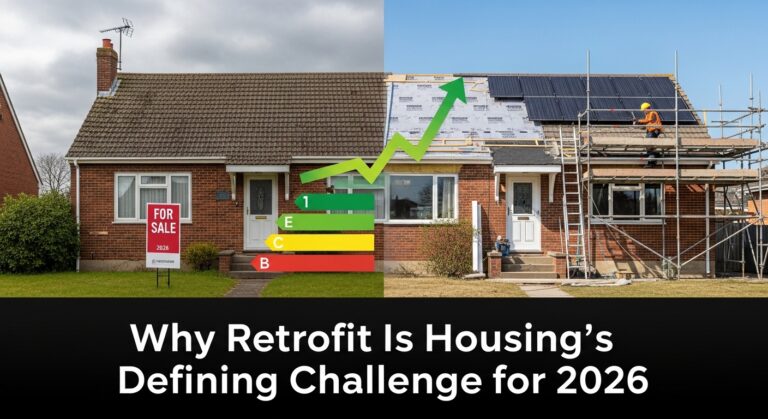
For years, retrofit barely made headlines. Early progress was driven mostly by private homeowners, while councils and housing associations moved cautiously. That landscape has shifted. As 2026 approaches, retrofit has become one of the most complex, urgent and high‑stakes issues in UK housing — touching everything from energy bills to long‑term health and net‑zero commitments.
High‑profile news stories and a recent National Audit Office review have reignited the conversation. The investigation into failures under earlier government schemes exposed widespread issues: poor‑quality insulation work, unresolved damp and mould, and a lack of accountability for the damage left behind. These failings have shaken public confidence and demonstrated that without proper oversight, retrofit can do real harm.
Back in 2020, council‑led demonstrator projects provided a safe starting point for testing technologies and delivery models. Yet many housing providers were pushed from small pilots straight into large‑scale retrofit programmes — often without the matching investment in skills, monitoring systems or coordination. This has contributed to inconsistent outcomes, higher compliance pressure and media scrutiny wherever installations have gone wrong.
The need for retrofit remains immense, but recent experience shows that success depends on getting the foundations right. So what should the sector focus on in 2026?
Closing the Green Skills Gap
The most urgent challenge is skills. The green‑construction workforce remains too small and too specialised. Young people and career‑changers often have little awareness of the full breadth of roles involved — from assessors and project managers to designers, coordinators and resident‑engagement specialists. Focusing solely on installation overlooks the talent needed to design and deliver effective whole‑home solutions. Even when skilled professionals are available, supply chains remain fragmented. Accredited installers struggle to find clear routes into new contracts, while main contractors often can’t secure reliable local delivery partners. These bottlenecks slow down programmes and make it harder to deliver social value and community benefits.
Retrofit Must Start With People, Not Products
Retrofit is not a one‑size‑fits‑all upgrade. Every home, resident and neighbourhood is different — and successful programmes recognise that. Effective retrofit considers how people actually live: how they heat their homes, how they ventilate, and how they interact with new technologies.
This human‑centred approach means:
• monitoring performance early
• embedding resident education in every project
• tailoring solutions to individual homes instead of chasing short‑term policy incentives
When residents understand their new systems and feel supported, retrofit delivers far better outcomes.
Learning From Past Failures
The insulation failures exposed by past schemes show what happens when quality, accountability and consistency take a back seat. Sub‑standard work, conflicting programme requirements and inconsistent oversight have undermined trust and wasted public money.
Moving forward, the sector must commit to:
• rigorous quality control
• consistent standards
• strong monitoring and evaluation
• shared accountability across all delivery partners
Schemes such as SHDF and the upcoming Social Housing Decarbonisation Fund Wave 3 already demonstrate how clearer frameworks can raise standards across the board. These should become the template for future programmes.
Turning Innovation Into Real‑World Delivery
Even with the challenges, innovation across the retrofit sector is gathering pace. The Big Retrofit Challenge, delivered by the National Home Decarbonisation Group with Innovate UK and Futurebuild, is surfacing new technologies and approaches that could transform the speed and affordability of retrofit.
Last year’s innovators ranged from natural, low‑carbon insulation products like Indie Nature’s hemp‑based materials to advanced digital tools improving design accuracy and risk assessment. At United Infrastructure, these innovations are now being embedded directly into live projects — including bringing Indie Nature into the Travis Perkins supply chain to enable widespread deployment.
The 2026 Challenge, now open for applications, will showcase the next wave of finalists at the National Retrofit Conference during Futurebuild 2026 at ExCeL London. Finalists will pitch their solutions live, appear on the NHDG pavilion and engage with housing providers and partners looking for scalable innovations that can accelerate national decarbonisation.
A Pivotal Moment for the UK Housing Sector
Retrofit will define the next decade of UK housing — no other agenda affects energy use, affordability, tenant health, carbon emissions and building quality all at once. But retrofit also represents a once‑in‑a‑generation opportunity: to rebuild trust, create green jobs and improve homes at scale.
If the sector can address the gaps in skills, delivery and accountability — and embrace innovation through collaboration — 2026 could become the moment when the UK shifts from discussion to delivery.
Source – Based on insights originally shared by Laura Marks, Decarbonisation Project Manager at United Infrastructure and Head of the Innovation Working Group at the National Home Decarbonisation Group.